Ćiro Trail
Ćiro Trail
From Steam to Silence
Introduction
The Ćiro Trail follows the route of a former narrow-gauge railway along which the legendary Ćiro steam train operated in the early 20th century, connecting Mostar with eastern Herzegovina, the interior and the coast. Today, where steam locomotives once ran, cyclists, walkers and travelers move in search of a slower, continuous rhythm of travel.
This route was not created to conquer altitude, but to understand space through movement—a blend of industrial heritage, natural landscape and cultural layers that do not impose themselves, but reveal themselves gradually along the way.
ROUTE STRUCTURE AND CHARACTER
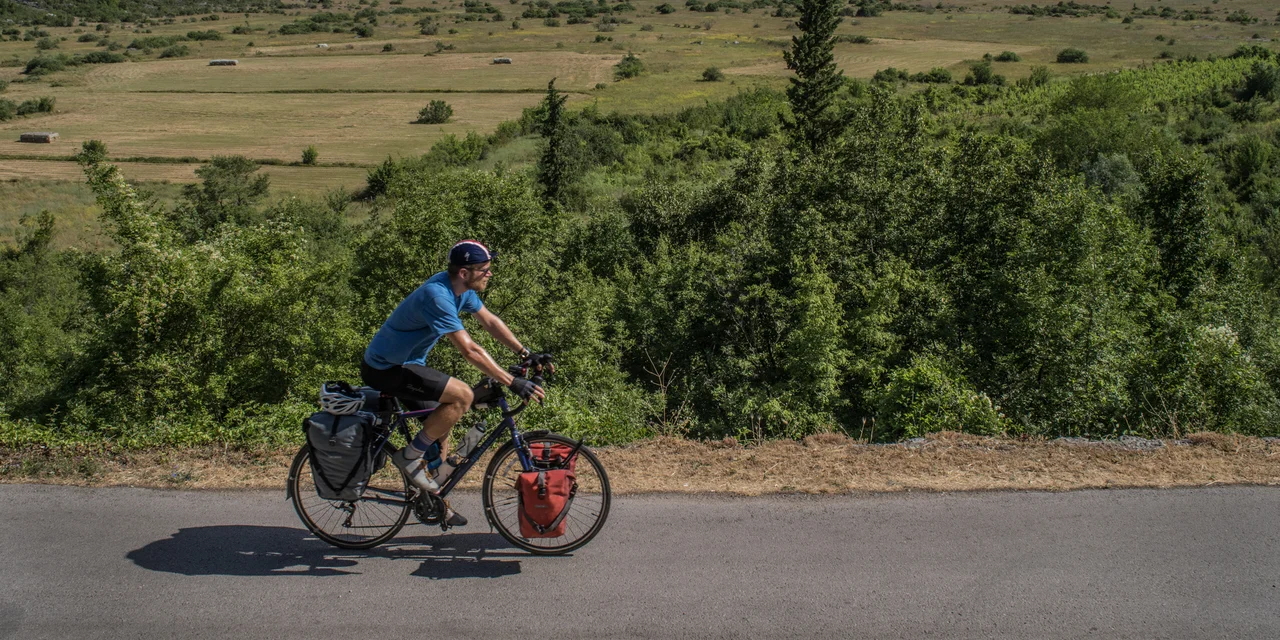
Ćiro Trail is a linear, technically easy and clearly defined route, with gentle gradients that follow the logic of the former railway. This characteristic makes it accessible to a wide range of users and suitable for multi-day journeys without major physical strain.
The route passes through:
- Herzegovinian karst landscapes and fields
- rural settlements
- abandoned railway facilities and infrastructure
The path itself leads the way—orientation rarely becomes an issue.
WHO IT APPEALS TO – AND WHY
Ćiro Trail is ideal for travelers seeking distance, context and continuity, without the technical demands of mountain routes.
It is particularly appealing to:
- cyclists (recreational and touring)
- families with older children
- walkers and light hikers
- travelers interested in industrial and cultural heritage
This is a route that allows movement, but encourages stopping.
HIGHLIGHTS ALONG THE ROUTE
Eiffel Bridge
One of the most recognizable symbols of the Ćiro Trail. This metal structure, designed according to late 19th-century engineering principles, is often colloquially referred to as the “Eiffel Bridge.” Today it serves as a visual landmark and a natural stopping point along the route.
Railway Guard Houses
Small stone buildings—former railway guard houses—are scattered along the track. They bear witness to the everyday life of the railway: the rhythm of work, waiting and supervision, and today lend the route a quiet, almost open-air museum quality.
Ravno Station
The former railway station in Ravno is one of the key historical and logical stops on the route. It is a place where industrial heritage meets local life, and where the Ćiro Trail naturally connects with other attractions of eastern Herzegovina.
Vjetrenica Cave
One of the most important natural attractions in the region, Vjetrenica Cave lies in close proximity to the route and represents a natural extension of the journey. Visiting Vjetrenica adds another dimension—a meeting with an underground landscape that is just as slow, quiet and impressive as the trail itself.
WHAT YOU CAN EXPECT
Movement along the Ćiro Trail is steady and unobtrusive. You pass through tunnels that require a brief slowdown, across bridges that open up views, and along sections where the landscape changes gradually, almost imperceptibly.
The climbs are gentle, the pace natural, and the route encourages spontaneous stops—for photography, conversation, or simply observing the space through which you are moving.
SUSTAINABILITY AND HERITAGE
Ćiro Trail is an example of how abandoned infrastructure can be transformed into a contemporary, sustainable tourism resource. The route:
- preserves industrial and transport heritage
- supports local tourism and small communities
- connects places outside the main tourist flows
Nothing new is built here—the existing is reinterpreted.
PRACTICAL TIPS
- Ideal for cycling and light hiking
- Tunnels require lighting and good visibility
- Start early in summer due to high temperatures
- The route is mostly clearly marked
- Easily combined with local excursions and attractions


